

How Screen Time Affects Your Child's Brain Development
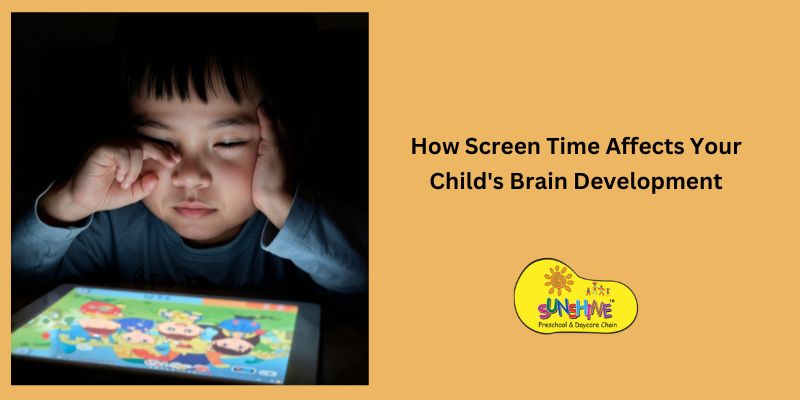
Here is a number that should make every parent pause: over 60% of Indian children aged 2 to 5 spend between two and four hours on screens every single day. Not in a classroom. Not in conversation. In front of a device.
For working parents, this is rarely a choice made lightly. When both parents are at the office and childcare options are limited, a tablet becomes the most convenient solution in the room. It keeps children quiet, occupied, and, on the surface, seemingly engaged.
But what is actually happening inside a young child's brain during those hours? And what are the long-term consequences of high screen time at a stage when the brain is developing faster than it ever will again?
This blog explores what the research says about how screen time affects brain development in early childhood, what warning signs parents and employers should know, and what structured alternatives, such as quality crèche environments, can do to protect and nurture young minds.
What Happens to a Child's Brain in the First 5 Years
The first five years of life represent the most extraordinary period of human brain development. By the time a child turns five, their brain has already reached nearly 90% of its adult size. Every experience, interaction, and environment during this window leaves a neurological imprint. Children develop nearly 1 million new neural connections every second in their early years.
This rapid growth is driven by what neuroscientists call neuroplasticity, the brain's remarkable ability to form and reorganise connections in response to stimulation. During this period, children are not just absorbing information. They are literally building the architecture of their cognitive, emotional and social selves.
Positive stimulation, such as conversation, play, physical activity and caregiver interaction, builds strong, well-connected neural pathways. Passive, repetitive or overstimulating experiences, such as excessive screen time, can disrupt this process at a stage when disruption is most consequential. This is why the first five years are not simply important. They are decisive.
(For a deeper look at early brain development milestones, see our blog: Early Childhood Brain Development: The Critical First 5 Years)
How High Screen Time Affects the Developing Brain
The effects of screen time on brain development are not uniform. They depend on the type of content, the duration and whether a caregiver is present. However, when screen use is passive, prolonged and unsupervised, research consistently identifies several areas of concern:
Attention Span and Focus
Young children's brains are wired to seek novelty. Screens, with their rapid cuts, sounds and animations, deliver constant novelty at a speed the real world simply cannot match. Over time, this trains the brain to expect rapid stimulation, making it harder for children to sustain focus during slower, more demanding tasks such as listening, reading, or problem-solving.
Language and Speech Delays
Language development depends on back-and-forth interaction. A child speaks, an adult responds, and the child responds again. Screens deliver one-way input. Studies have found that children with high screen exposure in the early years are more likely to show delays in vocabulary acquisition, sentence construction and conversational ability.
Social and Emotional Development
Reading facial expressions, understanding tone of voice and learning empathy are skills children develop through real human interaction. Screen time displaces these interactions, reducing the volume of emotional cues a child is exposed to and processes during critical developmental windows.
Sleep Disruption and Memory Consolidation
Screens, particularly in the hour before sleep, suppress melatonin production and interfere with the deep sleep stages during which the brain consolidates learning. For young children, this is not just a matter of tiredness. It directly impairs the brain's ability to retain what it has learned during the day.
The ‘Virtual Autism’ Concern in India
Indian paediatricians have recently begun flagging a pattern they refer to as "virtual autism", where children with no genetic markers for Autism Spectrum Disorder display autism like symptoms, including speech delays, social withdrawal and repetitive behaviours, following prolonged screen exposure from infancy. In some clinical observations, over 70% of such cases showed a direct correlation with excessive screen use. Significantly, many of these children showed measurable improvement when screen time was reduced and replaced with structured human interaction.
The Working Parent's Dilemma
Understanding these risks is one thing. Acting on them when you are managing a full-time career is another matter entirely.
India's urban workforce is increasingly dual-income. Nuclear families are the norm. Extended family support, once a reliable childcare buffer, is less available than it was a generation ago. For many working parents, particularly mothers who have recently returned from maternity leave, the challenge is not a lack of awareness. It is a lack of alternatives.
When a parent is on a video call, and a toddler needs to be occupied, a screen is immediately available. A structured activity is not.
The guilt that follows is real and common. But guilt without an alternative is not a solution. What parents need is access to environments where trained caregivers can provide the stimulation, interaction and routine that young brains require. What many corporate employees in India currently lack is affordable, accessible and proximity-based childcare.
There is a better alternative, and increasingly, it is one that forward-thinking employers are making possible.
How a Structured Crèche Environment Counters These Effects
A quality crèche provides the specific developmental conditions that screens cannot, and that working parents cannot always deliver during a busy workday.
Screen Free, Activity-Based Engagement
In a well-designed crèche, children spend their time in structured, purposeful activity such as storytelling, art, music, sensory play and guided exploration. These experiences activate multiple brain areas simultaneously, building neural connections that passive screen consumption suppresses.
Caregiver-Led Interaction
Trained caregivers provide the back-and-forth conversational interaction that is essential for language development. Every question asked, every response encouraged, and every story read aloud is a neurological investment that a screen cannot replicate.
Routine and Emotional Regulation
Structured daily routines, including consistent mealtimes, rest periods, play sessions and learning activities, provide the predictability that young children's nervous systems need to develop emotional regulation and self-confidence.
Sunshine's Phydigital Approach
At Sunshine, we recognise that technology is part of a child's world, and we do not believe in eliminating it. Our Phydigital model combines the best of hands-on, caregiver-led learning with purposeful, age-appropriate digital tools used under supervision. Children benefit from technology as a resource, not as a replacement for human connection.
What Employers Can Do: The Business Case for Corporate Crèches
Childcare is not just a family issue. It is a workforce issue, and increasingly, Indian organisations are recognising this.
When employees are worried about their children's care and development, that concern does not stay at the door. It follows them into meetings, onto calls and into the quality of their work. Research consistently shows that employer-supported childcare reduces absenteeism, increases productivity and significantly improves retention, particularly among women returning from maternity leave.
The Maternity Benefit (Amendment) Act, 2017, mandates crèche facilities for organisations with 50 or more employees. However, compliance is a baseline, not the end goal. Organisations that go beyond compliance and offer structured childcare as a meaningful benefit demonstrate a deeper commitment to employee wellbeing.
A corporate crèche is not a perk. It is an investment in early brain development, in employee trust and in long-term workforce stability.
When employees know their children are in a safe, engaging and developmentally supportive environment, rather than being passively occupied by a device, they are able to work with greater focus and significantly less stress. This is measurable business value.
Conclusion
The evidence is clear. Prolonged and unsupervised screen time during early childhood carries real developmental risks, affecting attention, language, social skills, sleep and emotional regulation.
The solution is not to place blame on working parents. It is to create better alternatives.
Structured crèche environments provide what screens cannot: human interaction, guided learning and developmentally appropriate stimulation.
Organisations that invest in childcare solutions are not only supporting their employees. They are contributing to the development of a healthier, more capable future generation.
Partner with Sunshine Preschool and Corporate Crèche to create structured childcare environments that enable your workforce to perform with confidence and focus.

Be the first to post a comment
Leave a Reply Cancel reply