

From Morning Drop-Off to Evening Pick-Up: How Peer-to-Peer Learning Shapes a Child's Day at a Corporate Crèche
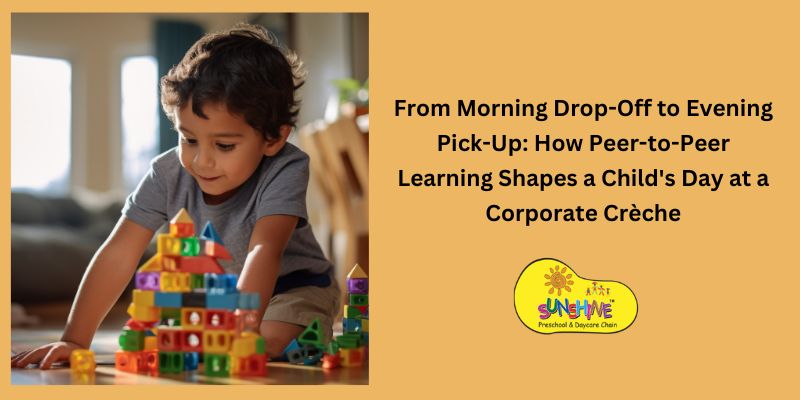
There is a moment every working parent knows. The bag is handed over. The child looks up. You turn to leave. And somewhere between the car park and your desk, you spend the next hour wondering: what is actually happening back there?
It is a fair question. And for most parents, the honest answer is that they do not know for certain. They trust the facility. They like the teachers. But the interior life of a corporate crèche, what fills those eight or nine hours, remains largely invisible.
This piece is an attempt to make it visible. Because what happens between morning drop-off and evening pick-up is not just supervised waiting. It is, if the environment is designed well, one of the richest developmental experiences a child under six can have. And at the centre of it is something deceptively simple: other children.
The Morning: Arrival, Settling In, and the First Sparks of Connection
The first thirty minutes of a child's day at a professional corporate crèche are more intentional than they appear.
Arrival is not simply a handover. In a well-run facility, it is a ritual. Children are greeted by name. Bags go to a familiar hook. A caregiver checks in with a word or a look. These micro-moments of consistency matter enormously for children aged two to five, whose nervous systems are still learning to regulate in unfamiliar environments.
But what shifts the morning from settling in to learning is what happens next: the child notices another child.
Before any structured activity begins, peer interaction is already underway. A toddler offers a block. Two children briefly argue over a toy and then, without adult intervention, resolve the dispute. A three-year-old who was tearful at drop-off is drawn into a game by a peer who has been attending for six months. That child has already learned that this room is safe.
This is peer-to-peer learning in its earliest form. Not curriculum-driven, not teacher-led. Child to child. And for working parents placing their child in daycare for the first time, this organic social scaffolding is often what their child needs most.
Mid-Morning: Where the Real Learning Happens
By mid-morning, the day's structured activities are underway. And this is where the developmental science of peer interaction becomes most visible.
Research in early childhood education has consistently shown that children learn differently from peers than they do from adults. When a caregiver explains a concept, the child receives information. When a peer demonstrates the same thing, the child engages with it. The cognitive distance between a three-year-old and a trained adult is so vast that instruction, however warm, can feel abstract. Between two three-year-olds, the distance collapses. The learning becomes immediate, relevant, and deeply motivating.
At Sunshine, mid-morning typically includes collaborative activities designed with this in mind. Group storytelling exercises where children build narratives together. Art projects that require sharing materials and making collective decisions. Early numeracy games are introduced that work only when played in pairs or small groups. None of these is accidental. They are structured to create the conditions for peer-to-peer learning to flourish naturally.
What children take from these sessions goes beyond the activity itself. They are practising turn-taking, reading social cues, managing the frustration of not always getting their way, and experiencing the satisfaction of contributing to something larger than themselves. These are not soft skills. They are the foundational competencies that determine how a child will function in a classroom, a team, and eventually a workplace.
Afternoon: The Underrated Power of Shared Routines
The quieter part of the day carries its own developmental weight.
Lunchtime at a corporate crèche is not simply a meal break. Around a shared table, children observe, imitate, and practice the social choreography of eating together. A child who refuses vegetables at home will sometimes eat them because a peer does. A child who eats too quickly begins to slow down when the group's pace is unhurried. Behaviour that resists adult instruction often quietly yields to peer example.
Rest time follows. For younger children, especially, the ability to settle and rest in a group environment builds emotional regulation in ways that solitary naps at home do not. They learn to be calm alongside others. They learn that the room is still there when they wake up. They learn, in the most bodily way possible, that this place is safe.
For parents who worry about what their child does "all afternoon," the honest answer is this: they are learning to be with other people. That is not a small thing.
Late Afternoon: What Children Teach Each Other
The late afternoon belongs to unstructured play. And this is where some of the most important learning of the day takes place, precisely because no adult is directing it.
Left to navigate play on their own terms, children negotiate. They assign roles, challenge rules, test boundaries, and discover that other children's preferences do not always match their own. A child who wants to be the leader every time will eventually encounter a peer who wants the same thing. The resolution of that tension, arrived at without a caregiver stepping in, is a developmental milestone in miniature.
This is also where empathy takes root. A child who sees a peer fall and goes to check on them is not following an instruction. They are responding to something they recognise. Peer interaction at this age creates a rehearsal space for emotional intelligence that no screen, however interactive, can replicate.
This is worth saying plainly. A child watching a tablet in the late afternoon is passively consuming content. A child in a room full of peers is producing social experience, in real time, with real consequences, and real rewards.
What This Means for Working Parents
Most parents who use corporate daycare carry a quiet concern: that they are choosing work over their child's well-being, and that this choice has a cost.
It is worth sitting with that honestly, because the concern is not irrational. It comes from love. But the evidence from early childhood development research points in a direction that many parents do not expect. Children who spend structured, well-managed time in peer-rich environments often develop stronger social competencies, greater emotional resilience, and more advanced language skills than children who spend the same hours in one-to-one care.
The corporate crèche, when it is done well, is not a compromise. It is an environment that a working parent's home, however loving, cannot fully replicate. The peer group is the differentiator.
What Makes the Difference
Not all daycares for working parents are equal, and it is worth being clear about what distinguishes a professional corporate crèche from informal childcare arrangements.
Trained caregivers who understand child development at each stage. Age-appropriate peer groupings that allow both stretch and comfort. A curriculum that creates intentional peer learning opportunities rather than filling time. Consistent routines that give children the predictability they need to take social risks. And safety and hygiene standards that allow parents to leave without the low-level anxiety that undermines focus for the rest of the working day.
These are not features. They are the conditions under which peer-to-peer learning actually happens.
In Conclusion
The drop-off moment will probably always carry some weight. That is not something a crèche can entirely resolve, nor should it try to. But there is a difference between leaving and not knowing, and between leaving and leaving with a clear picture of what your child's day actually looks like.
From the first peer interaction of the morning to the unstructured play of the late afternoon, a professional corporate crèche is not holding your child until you return. It is giving them something to carry back: the beginnings of a social self, built in the company of other children, one ordinary day at a time.
If you would like to learn more about Sunshine's Corporate Crèches across India, we would be happy to walk you through a typical day at a centre near you.

Leave a Reply Cancel reply